Engineering projects and technical solutions
Welcome to my engineering portfolio. Based currently in Terre Haute, Idiana, I develop robust mechanical and aerospace solutions combining rigorous simulation, 3D modeling, and rapid prototyping. Explore some of my projects below featuring surgical tools, aerodynamic optimization for disaster relief UAVs, and finite element stress analysis for aerospace components.
Disaster Relief Drone
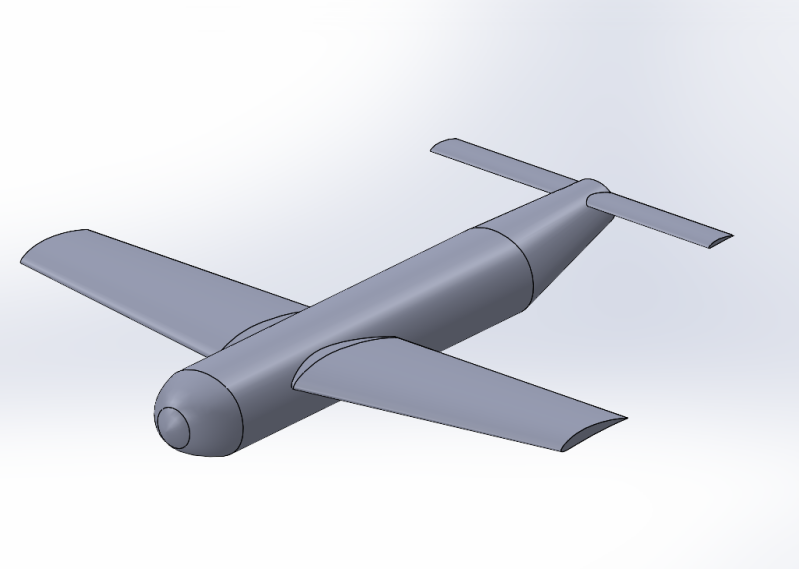
This disaster relief drone is a VTOL vehicle—electrically powered and 3D printed—designed to deliver critical first aid supplies over long distances, such as those between aid stations and the heart of a natural disaster. Its payload carries enough calories and water purification tablets to feed five families of four for a day. The goal of the project is to provide cheap, reusable alternatives to current methods of delivering relief to victims of natural disasters.
The work on this drone was slow to start, since I didn't know what problem to address. Should it be delivering perishable goods across vast distances? Organ transplants? Eventually I settled on delivering crucial relief supplies like high-energy biscuits and water purification tablets, partially because of my own budget and partially because a colleague encouraged the idea. For a while, I was stuck in analysis paralysis, continuing to only use MATLAB to estimate the lift of my tapered wings using Schrenk's lift distribution.
After a lot of deliberating, I decided it was best to start with rough numbers when building my solid model and then improve it iteratively. I started with a model in SolidWorks with the intention of moving it to CATIA 3D Experience. I then used the free simulation software XFLR5 to get lift and drag estimates for the vehicle, which allowed me to go back and revise my initial guesses for dimensions and shape.
This project is still a work in progress, since balancing clubs and homework is difficult—as I'm sure many can understand.

Landing Link
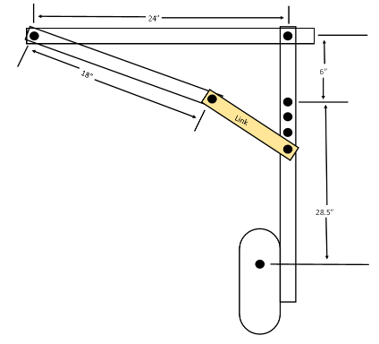
The goal of this project was to develop a link for an aircraft landing gear that could withstand the forces imposed on it by a retracting wheel while being as light as possible.
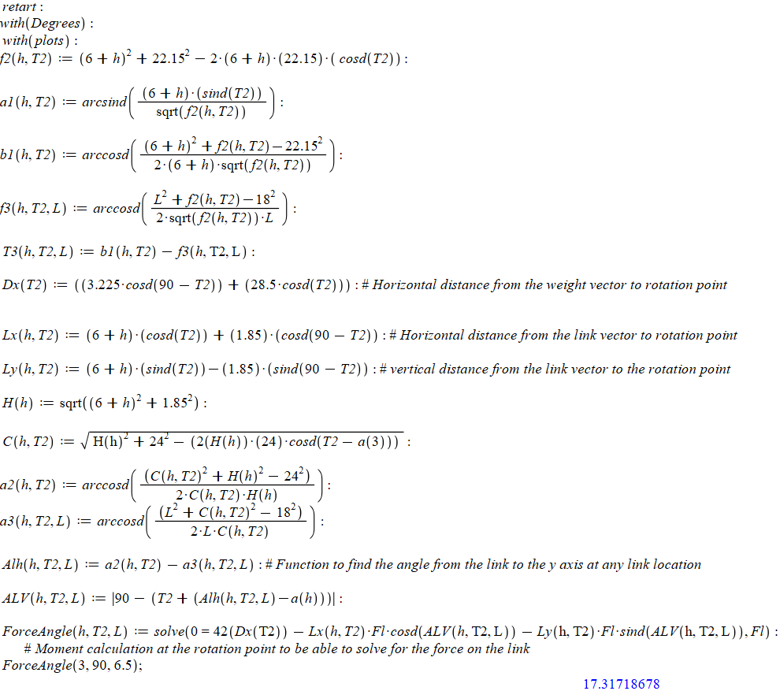
The biggest initial challenge was deriving all of the trigonometric relationships between the various angles of the system's components. My teammates and I became stuck once we had our angle estimates, since statics is intended for stable, non-moving systems, and we were unsure how to proceed with a dynamic mechanism. We also faced the problem of determining an appropriate landing gear length, as there was no definite geometry to work from.
Eventually, we realized the most efficient approach was to find the greatest force exerted on the link at every angle throughout the retraction movement for a specified length, which allowed us to compare the maximum loads. From there, we performed a straightforward axial load stress calculation to reverse engineer the required dimensions.

Stryker tool Sheath for BrainPath
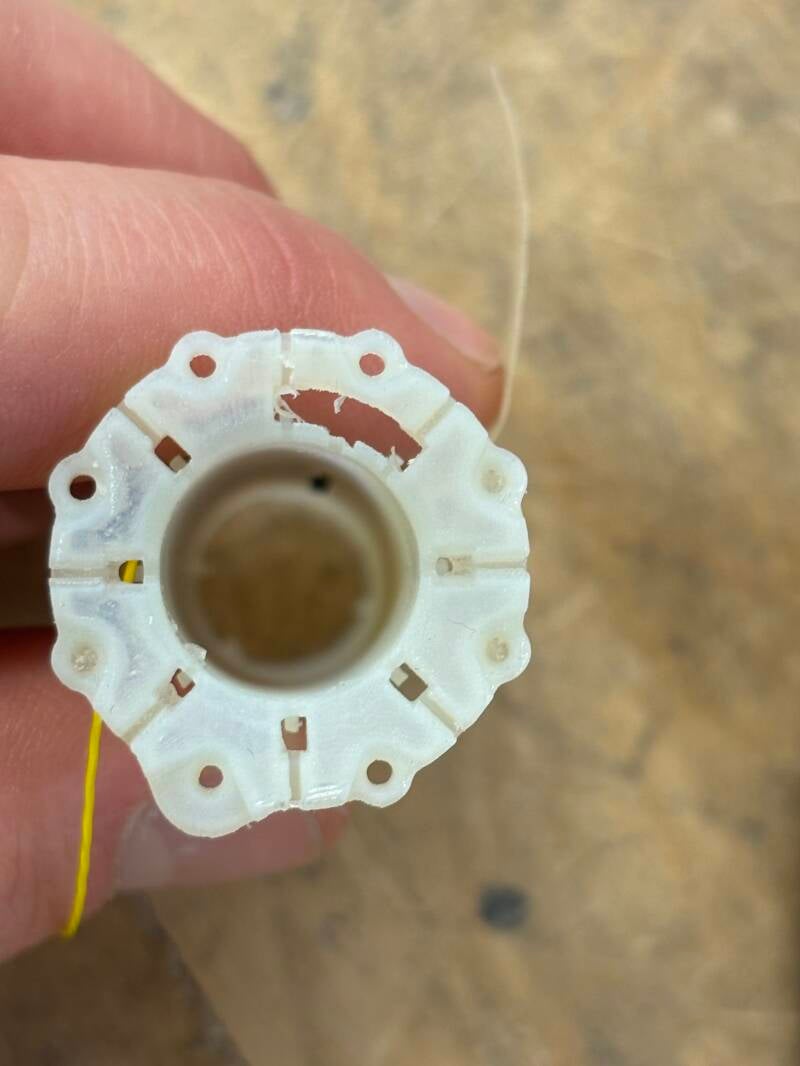
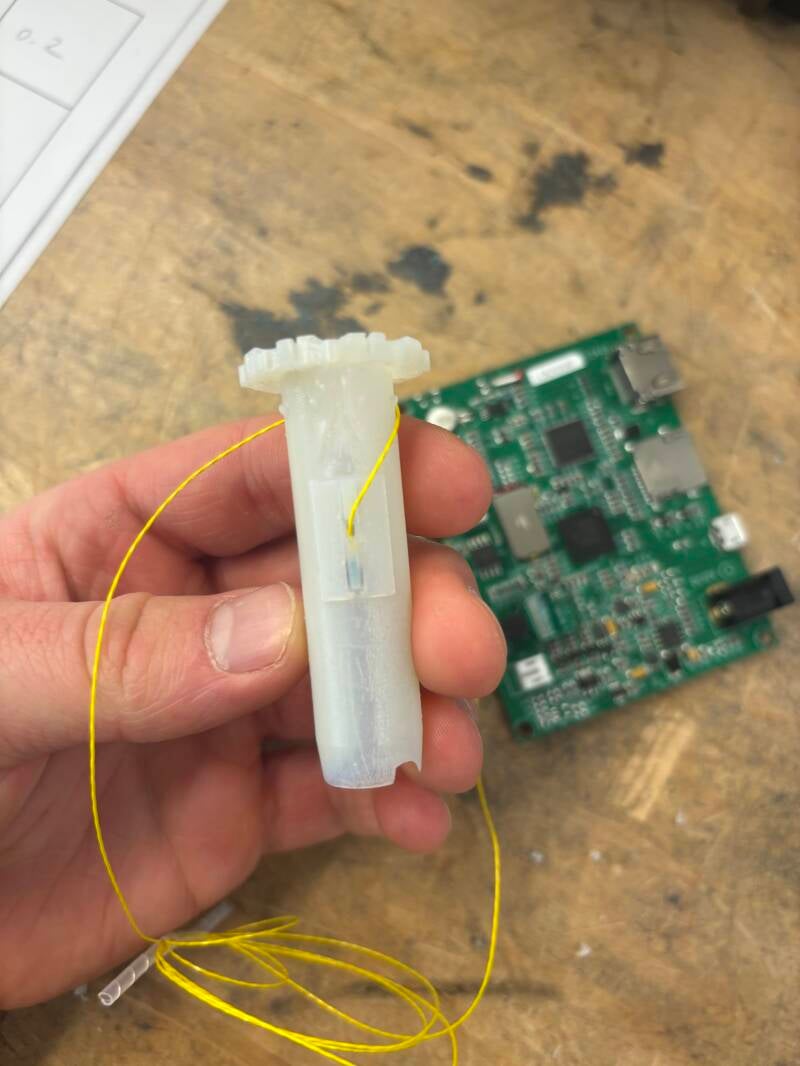
During my work at Rose-Hulman Ventures, I redesigned the sheath of a surgical tool to increase internal working volume and improve surgeon usability.
The previous design routed the main light source through the interior of the tube, consuming space and making the tool difficult to operate. My task was to create a sheath with no lights or cameras on the inside, while keeping the outer diameter increase to no more than 0.003 inches—a constraint that limited me to subtractive modifications initially and restricted available hardware.
I began by identifying the original manufacturing method, injection molding, and enlarged one of the injection jig holes to route the wires externally. Next, I modeled a flared and tapered entry in SolidWorks to spread light onto three points around the sheath and angle the camera toward the work area, then iterated on the dimensions using 3D-printed prototypes.
The final challenge was ensuring correct camera orientation. After a circular drill hole proved insufficient, I designed an external jig with a square hole to hold the camera at the proper angle, attached via a thin curved panel with medical-grade glue. When the panel repeatedly broke due to its thinness, I added an internal lip to prevent the jig from being pushed too far into the sheath, keeping it securely in place.
The final design met the tight dimensional constraints while enabling external light and camera routing for improved surgical visibility and workspace.



Interested in collaborating or reviewing my qualifications?
Learn more about my technical background, software proficiencies, and career journey. Download my full resume, review comprehensive engineering credentials, or reach out directly to schedule an interview.
Create Your Own Website With Webador